Hydrogen Water Bottle PPB Explained: What Is the Best PPB Level?
You are comparing two hydrogen bottles online. One says 800 PPB. Another says 1500 PPB. A third promises 2000 PPB. Naturally, the biggest number looks like the obvious winner.
But is it?
If you are buying a Hydrogen Water Bottle, understanding PPB is one of the most useful things you can do before spending your money. It tells you how much dissolved molecular hydrogen the water contains, but the number needs context. Generation time, testing conditions, bottle design and how quickly you drink the water also matter.
Here is what PPB actually means and how Indian buyers can use it to compare hydrogen water bottles more intelligently.
What Does PPB Mean in a Hydrogen Water Bottle?
PPB means parts per billion.
For hydrogen rich water, it is commonly used to describe the concentration of dissolved molecular hydrogen, or H2, in the water.
A simple way to understand it is:
1000 PPB = approximately 1 mg/L of dissolved hydrogen
So, in concentration terms:
|
Stated Concentration |
Approximate Equivalent |
|
500 PPB |
0.5 mg/L |
|
1000 PPB |
1.0 mg/L |
|
1500 PPB |
1.5 mg/L |
|
1600 PPB |
1.6 mg/L |
|
2000 PPB |
2.0 mg/L |
This conversion makes comparing products easier because some manufacturers use PPB while research papers may report dissolved hydrogen in mg/L or ppm.
For dilute water solutions, 1000 PPB is approximately equivalent to 1 ppm, which is approximately 1 mg/L.
The important word here is concentration. PPB tells you how concentrated the hydrogen is in the water. It does not, by itself, tell you that one bottle will produce a particular health result.
Is Higher PPB Always Better?
Not necessarily. When comparing hydrogen water bottles, a higher PPB number can look more impressive, but it does not automatically mean the bottle is better.
For example, seeing 2000 PPB next to 800 PPB does not mean the first bottle is simply 2.5 times better. Hydrogen concentration can vary depending on the generation technology, bottle design, pressure, temperature, cycle time and testing conditions.
So, instead of looking at PPB alone, ask:
- How was the hydrogen concentration measured?
- How long is the generation cycle?
- What technology does the bottle use?
- Is the stated PPB a maximum or consistent output?
- Is the bottle designed to retain dissolved hydrogen?
PPB is a useful comparison point, but it should be considered alongside the bottle’s technology, design and overall specifications.
Why Hydrogen Does Not Stay in Water Forever
Here is something every buyer should understand before comparing Hydrogen Water Bottles.
Hydrogen is an extremely small molecule. Once it has been dissolved into water, it can gradually escape.
Scientific reviews note that controlling dissolved hydrogen can be challenging because hydrogen is lost over time.
This has a practical consequence.
Imagine that your bottle produces hydrogen rich water and you leave it sitting open on your desk for several hours. The concentration you eventually drink may not be identical to the concentration present immediately after generation.
That is why instructions for portable hydrogen bottles commonly recommend consuming the water relatively soon after the cycle.
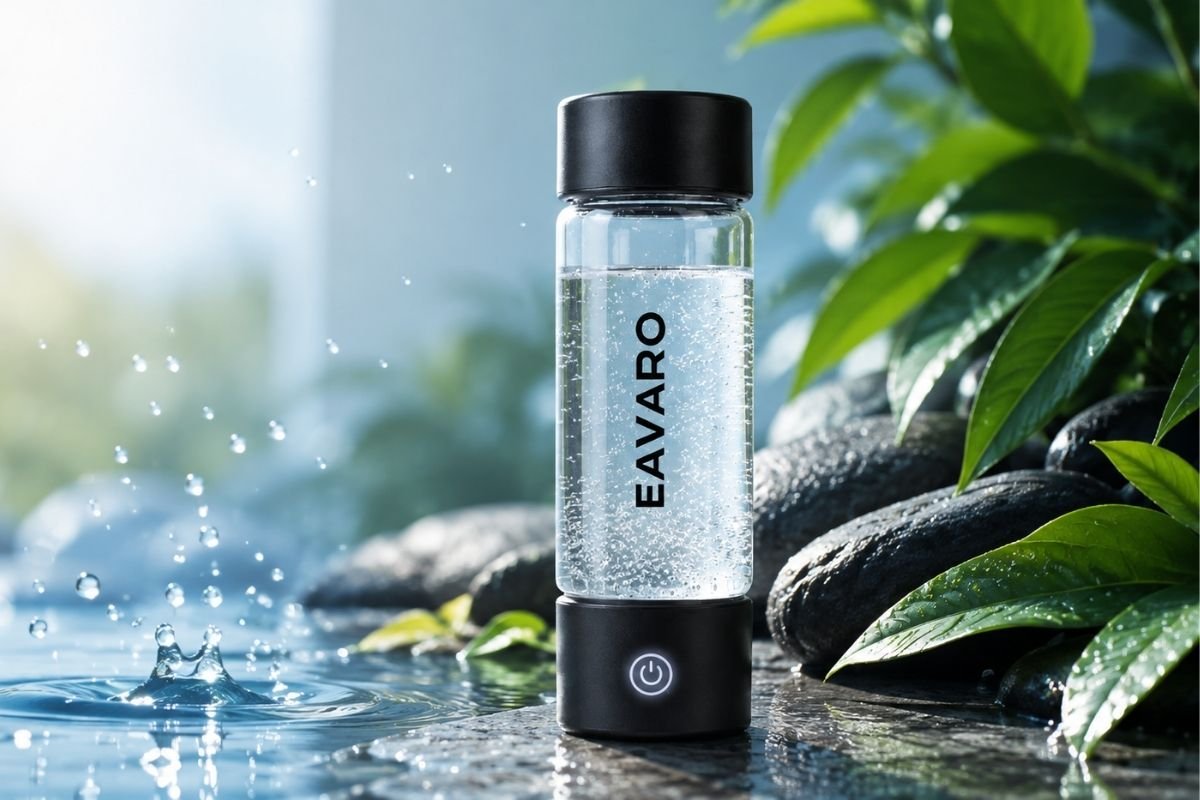
Eavaro, for example, instructs users to fill the bottle with drinkable water, activate its three minute generation cycle and consume the hydrogen enriched water immediately after the cycle finishes.
This is a good reminder that PPB should not be considered separately from how you actually use the bottle.
How Much PPB Should You Look for?
There is no universally established PPB number that every person needs to drink.
Research into hydrogen rich water is still developing. A systematic review identified 30 human studies meeting its criteria and found research across several health related areas, while also highlighting the need for larger and longer studies.
That means it would be misleading to say that everyone needs a particular PPB concentration for a specific health result.
For shopping purposes, use PPB as a comparison specification, not a medical dosage.
When looking at a Hydrogen Water Bottle India product listing, you can use this framework:
Below 1000 PPB
The bottle is generating measurable dissolved hydrogen, but compare its output and cycle time carefully with other options.
Around 1000 to 1600 PPB
This range overlaps with concentrations commonly discussed in scientific literature on hydrogen rich water.
Above 1600 PPB
Do not automatically assume the claim is impossible or superior. Instead, look at how the bottle achieves and measures the concentration.
If a product advertises a particularly high PPB figure but provides no explanation of its technology, cycle time or measurement, the number alone should not make the buying decision for you.
Why 1600 PPB Appears So Often
If you have already researched hydrogen water, you have probably seen 1.6 ppm or 1600 PPB mentioned repeatedly.
There is a reason.
Scientific literature reports that molecular hydrogen reaches approximately 1.6 mg/L in water at standard ambient temperature and pressure.
Since approximately 1 mg/L equals 1 ppm in water, that becomes roughly:
1.6 mg/L = 1.6 ppm = 1600 PPB
But that should not be misunderstood as a universal maximum under every possible generation condition.
Pressure, temperature, generation technology, container design and measurement conditions can affect dissolved gas concentration.
This distinction becomes important when comparing newer portable systems advertising concentrations above 1600 PPB.
What About Eavaro’s Up to 2000 PPB Claim?
Eavaro’s current product page lists its Hydrogen Water Bottle at up to 2000 PPB during a three minute cycle.
The wording “up to” matters. It describes the manufacturer’s stated maximum output rather than promising that every glass of water under every possible condition will contain exactly 2000 PPB.
Eavaro also states that its bottle uses an SPE/PEM electrolysis system with a four layer electrolytic structure.
The bottle has a 460 ml capacity and a rechargeable 700mA lithium ion battery. Its current product specifications also list borosilicate glass construction and a one year warranty.
For someone comparing specifications, the combination is more useful than looking at 2000 PPB alone:
|
Eavaro Specification |
Current Product Listing |
|
Hydrogen concentration |
Up to 2000 PPB |
|
Generation cycle |
3 minutes |
|
Technology |
SPE/PEM electrolysis |
|
Electrolytic structure |
4 layers |
|
Capacity |
460 ml |
|
Material |
Borosilicate glass |
|
Battery |
Rechargeable, 700mA |
|
Warranty |
1 year |
That gives you a clearer picture of what you are buying.
Why SPE and PEM Matter When Comparing PPB
PPB tells you the result being claimed. The electrolysis system tells you something about how the bottle produces hydrogen.
SPE stands for Solid Polymer Electrolyte. PEM refers to a Proton Exchange Membrane.
In a hydrogen generator, electrolysis uses electrical energy to separate water into hydrogen and oxygen. A membrane based system is designed to manage the gases produced during that process.
Eavaro says its bottle uses SPE/PEM technology to generate hydrogen rich water during its three minute cycle.
As a buyer, you do not need to understand every chemical reaction occurring inside the base.
You should simply look for a manufacturer that clearly identifies its generation technology instead of offering a vague “hydrogen infused” claim with no explanation.
PPB Is Important, but These Features Matter Too
The Best Hydrogen Water Bottle is not automatically the model with the highest PPB printed on its page.
Use PPB as one part of your buying checklist.
Generation Time
A bottle that fits into your routine is more likely to get used.
If you plan to make hydrogen rich water at the office, before the gym or while travelling, a short generation cycle can be convenient.
Capacity
Check how much water the bottle holds.
A huge bottle may be inconvenient to carry. A very small one may require constant refilling.
Eavaro’s current model holds 460 ml, putting it in a portable format for desks, gym bags and everyday use.
Materials
Check what touches your drinking water.
Eavaro currently lists borosilicate glass and non toxic, FDA compliant materials in its specifications.
Rechargeability
Portable hydrogen generation requires power. A rechargeable battery means you do not need to keep replacing disposable batteries.
Warranty
A Hydrogen Bottle contains electronics and electrolysis components, so warranty coverage deserves more attention than it would with an ordinary water bottle.
Eavaro currently lists a one year warranty.
Do Not Confuse PPB With ORP
PPB and ORP are not the same thing.
PPB describes hydrogen concentration.
ORP means oxidation reduction potential and is usually measured in millivolts.
You may see negative ORP used in hydrogen water marketing, but an ORP reading is not a direct substitute for measuring dissolved molecular hydrogen concentration.
If your goal is to compare how much dissolved hydrogen different bottles claim to produce, look at the hydrogen concentration itself.
This is one reason PPB is a more straightforward specification for shoppers to understand.
Frequently Asked Questions
Is 2000 PPB good for a Hydrogen Water Bottle?
A stated output of up to 2000 PPB represents 2.0 mg/L in concentration terms. However, PPB alone does not establish health effectiveness. Look at the generation method, cycle time, measurement conditions and other product specifications too.
Is 1600 PPB the maximum amount of hydrogen in water?
Scientific literature commonly cites about 1.6 mg/L, or approximately 1600 PPB, as hydrogen saturation in water at standard ambient temperature and pressure. Different conditions, including pressure, can affect gas solubility.
Does higher PPB make a Hydrogen Bottle better?
Not necessarily. A higher verified dissolved hydrogen concentration can be a useful specification, but build quality, generation technology, cycle time, capacity, maintenance and warranty also matter.
What should I check when buying a Hydrogen Water Bottle in India?
Check PPB, SPE/PEM or other generation technology, cycle time, bottle material, capacity, rechargeable battery specifications, cleaning requirements, warranty and seller support.
What is the Best Hydrogen Water Bottle PPB?
There is no universally established PPB level that is “best” for every person or health goal. Instead of treating PPB as a medical dosage, use it as one measurable specification when comparing hydrogen water bottles.
Choose a Hydrogen Water Bottle by More Than a Number
PPB is worth understanding because it gives you a clearer way to compare products. But it should help you ask better questions, not encourage you to automatically buy the bottle with the largest number.
When choosing a Hydrogen Water Bottle, consider concentration alongside the technology that generates it, cycle time, bottle capacity, materials, charging convenience and warranty.
Eavaro’s current product page lists up to 2000 PPB from a three minute cycle, along with SPE/PEM technology, a 460 ml borosilicate glass bottle, rechargeable battery and one year warranty.
If you are comparing options in India, review the complete specifications before making your decision.
View the Eavaro Hydrogen Water Bottle to check the latest product specifications, price and availability.